
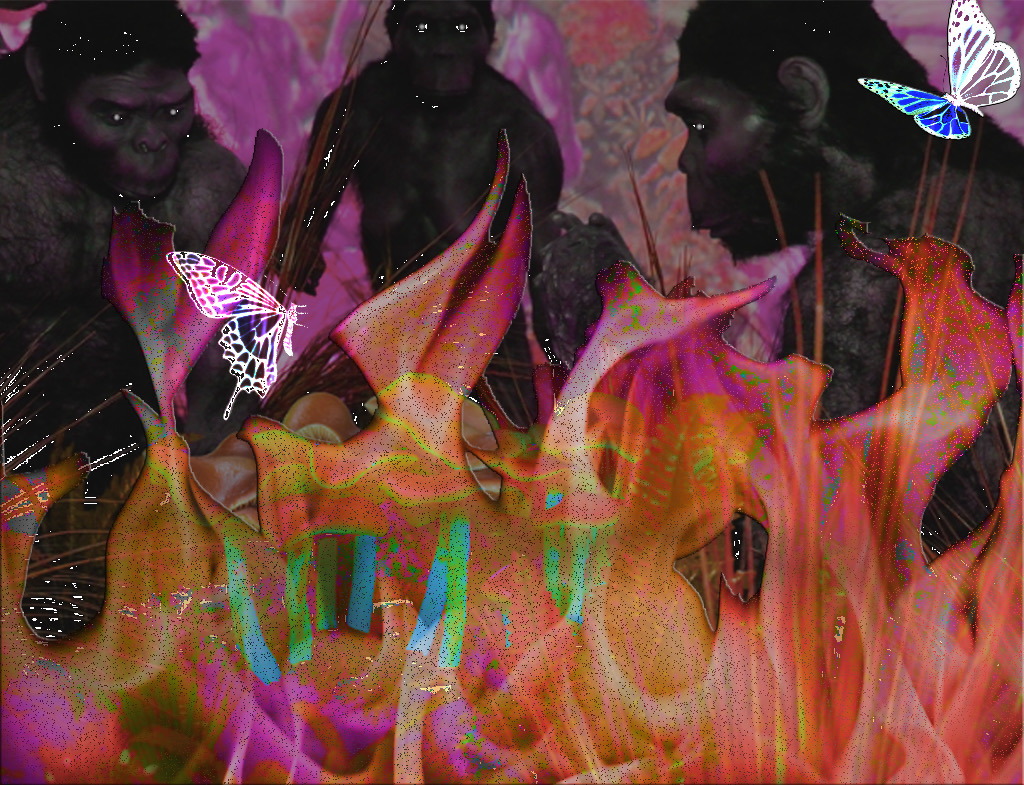
WORKSHOPS (On the time table it said it was part of web Design so I will be including them on this section of the blog) – The first workshop we did was an introduction to after effects and also using photoshop. I really enjoyed this workshop as I felt Arran was able to focus and help everyone individually. With this workshop we stated off creating images that could move but first we had to make a collage/ or image that had a story behind it. I have inserted mine below..
The second workshop consisted of learning basics of Colour grading, whilst using the programme DaVinci Resolve for this workshop It opened my eyes to actually realising that all films use colour grading, to me it was almost like a filter for each shot which makes so much difference to the film. To me this session was just a starter/ taster so I didn’t feel I gained a lot of knowledge but I definitely would like to explore this more in my own time ad I enjoy editing.
First brief – Was an online one which I struggled to set up at first, however managed to figure it out, from this session we were told that we had to either work in groups or alone and that the end product for this was to create a website/ blog that portrays a story/ any story to an audience. We were given the task to research a story and techniques we could use for our blogs.
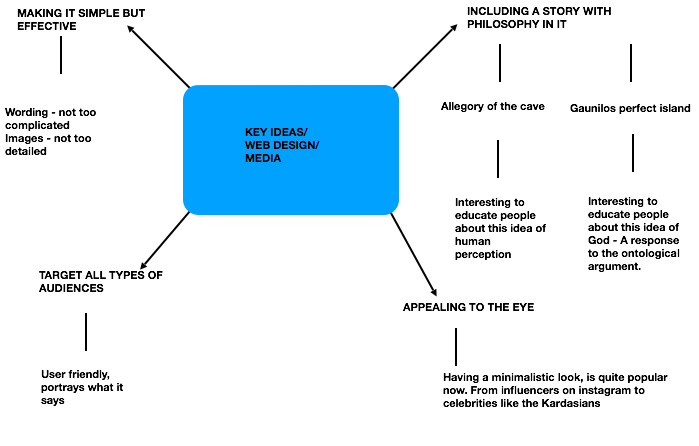
At first I decided to create a mind map as I always think its a great way in writing down your first initial thoughts down, they might change during the process. However, it is always good to have a starting point. Below I have inserted a simple mind map I created with my first notes/ and thoughts.
PLATOS CAVE RESEARCH – How it relates to us, the deeper understanding of the allegory
- I have always been interested in religion and philosophy since I can remember due to my upbringing but also my a level choices, which made me want to use a story/ allegory for my web/ blog design instead of a typical legend/ myth or a fable. What interests me with these types of stories/ allegories is that it has a relevance to life and society now.
- Plato claimed that knowledge gained through the senses is no more than opinion and that, in order to have real knowledge, we must gain it through philosophical reasoning.
The cave
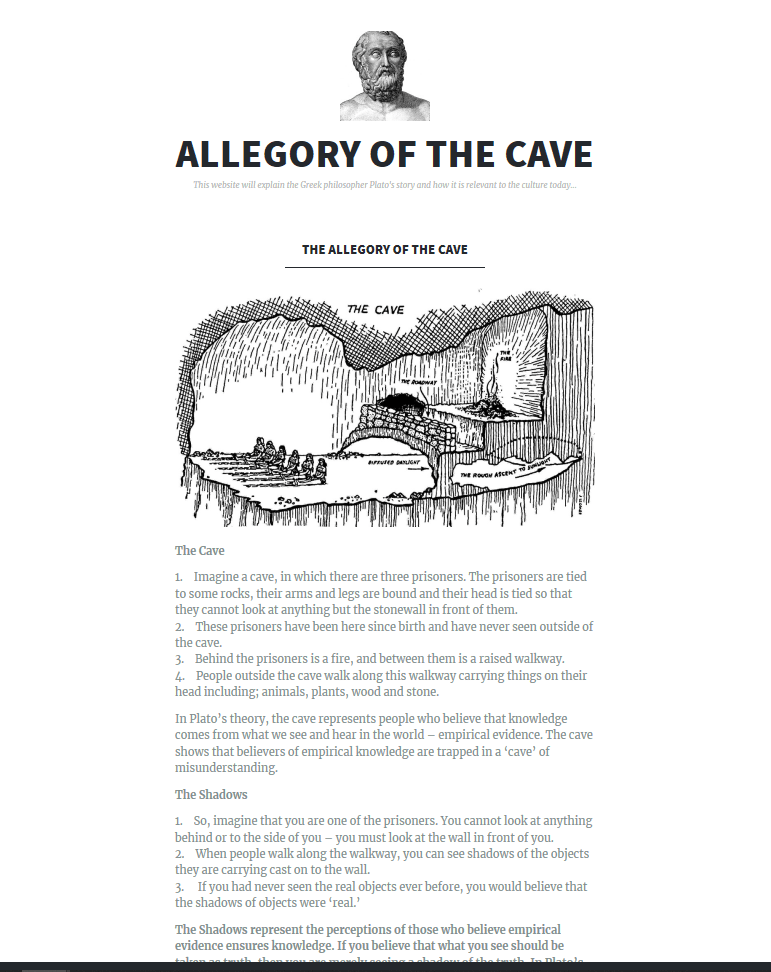
- Imagine a cave, in which there are three prisoners.
- The prisoners are tied to some rocks, their arms and legs are bound and their head is tied so that they cannot look at anything but the stonewall in front of them.
- These prisoners have been here since birth and have never seen outside of the cave.
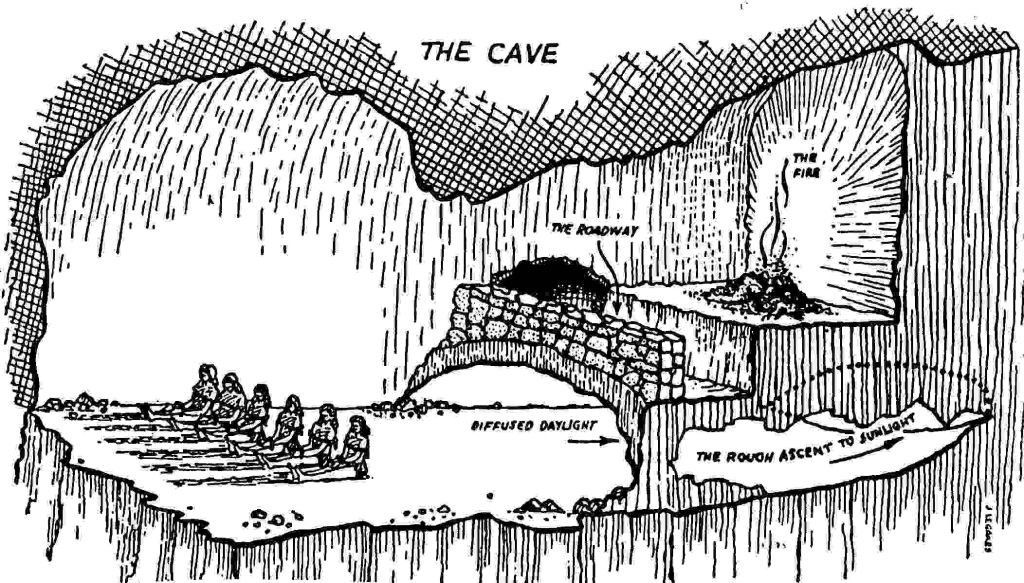
- Behind the prisoners is a fire, and between them is a raised walkway.
- People outside the cave walk along this walkway carrying things on their head including; animals, plants, wood and stone.
The cave In Plato’s theory, represents people who believe that knowledge comes from what we see and hear in the world – empirical evidence. The cave shows that believers of empirical knowledge are trapped in a ‘cave’ of misunderstanding.
Shadows
- Imagine that you are one of the prisoners. You cannot look at anything behind or to the side of you – you must look at the wall in front of you.
- When people walk along the walkway, you can see shadows of the objects they are carrying cast on to the wall.
- If you had never seen the real objects ever before, you would believe that the shadows of objects were ‘real.’
The Shadows represent the perceptions of those who believe empirical evidence ensures knowledge. If you believe that what you see should be taken as truth, then you are merely seeing a shadow of the truth.
The Game
- Plato suggests that the prisoners would begin a ‘game’ of guessing which shadow would appear next.
- If one of the prisoners were to correctly guess, the others would praise him as clever and say that he were a master of nature.
The Game represents how people believe that one person can be a ‘master’ when they have knowledge of the empirical world. Plato is demonstrating that this master does not actually know any truth, and suggesting that it is ridiculous to admire someone like this.
The Escape
- One of the prisoners then escapes from their bindings and leaves the cave.
- He is shocked at the world he discovers outside the cave and does not believe it can be real.
- As he becomes used to his new surroundings, he realizes that his former view of reality was wrong.
- He begins to understand his new world, and sees that the Sun is the source of life and goes on an intellectual journey where he discovers beauty and meaning
- He see’s that his former life, and the guessing game they played is useless.
The escaped prisoner represents the Philosopher, who seeks knowledge outside of the cave and outside of the senses. The Sun represents philosophical truth and knowledge. His intellectual journey represents a philosophers journey when finding truth and wisdom.
The Return
- The prisoner returns to the cave, to inform the other prisoners of his findings.
- They do not believe him and threaten to kill him if he tries to set them free.
The other prisoners reaction to the escapee returning represents that people are scared of knowing philosophical truths and do not trust philosophers.
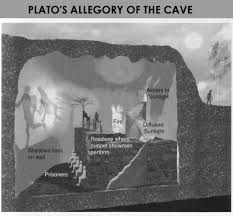
Images I liked that portrayed the Allegory of the cave (below), that I could use in my website to portray the story and my minimalist design.
GAUNILLOS PERFECT ISLAND RESEARCH –
Another example of philosophical ideology that I liked was Guanilo’s perfect island, he created this as it was a response to the existence of God/ The ontological argument.
The earliest critic of the ontological argument was a contemporary of Anselm’s, the monk Gaunilo of Marmoutier. Gaunilo did not identify any specific fault with the argument, but argued that there must be something wrong with it, because if there is not then we can use its logic to prove things that we have no reason to believe to be true.
For instance, Gaunilo argued, it is possible to construct an argument with exactly the same form as the ontological argument, that purports to prove the existence of the perfect island: the perfect island must exist, for if it did not then it would be possible to conceive of an island greater than that island than which no greater can be conceived, which is absurd.
If the ontological argument works, then, according to Gaunilo, the argument for the existence of the perfect island works too. The two arguments have the same logical form, and so they stand or fall together. The argument for the existence of the perfect island, though, is clearly spurious; we have no reason to believe that the perfect island exists. Gaunilo’s argument must be rejected. Unless the theist can point to some relevant difference between his argument for the existence of God and Gaunilo’s argument for the existence of the perfect island, then, then he will have to abandon the ontological argument for the existence of God.
Brief – Choosing our idea and how we are going to create the website.
My next brief was about how we are going to create the website we have been recommended to use sites such as Weebly, Squarespace, Wix and my chosen website WordPress. The ideas I wanted to establish were from my original ideas on my mind map, For instance the idea of the website being minimalistic due to using a complex philosophical allegory. I decided I wanted to stick to just Black and white and grey tones as I did nor really vision bright colours with this concept. The story I will be using is Plato’s Allegory of the cave as I felt more connected and more interested in comparison towards Guanlio’s idea of the perfect island.
The process of my website designing on WordPress was tricky at first as setting up to me can be the most difficult as you have not got a flow/ used to the website.
Steps I went through to create my WordPress Website:
First I had to create a new wordpress account as it doesn’t allow you to have two wordpress pages on one free account.
I then created my new wordpress page by coming up with a username, password and then the domain name. The domain name should be closely related to what the website’s purpose is and so I chose to use The Allegory of the Cave as my basis for the name. Unfortunately www.allegoryofthecave.wordpress.com was taken so I had to made a slight alteration and added an extra e to my domain. The final domain name was therefore www.allegoryofthecavee.wordpress.com.
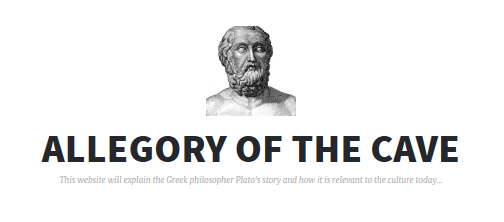
The website was launched when I verified my email address and I was ready to go and begin creating it in the image I had in my mind. Considering this website is about one of Plato’s philosophical stories I felt it had to clearly be about him and the story. I didn’t want loads of other visual information taking away from the key image and text I am trying to show.
Step 1 was using the WordPress theme menus to find a theme that suited my webpage for it’s purpose. Searching through the hundreds of themes there were a lot of complex ones but I managed to fine one which was elegantly simple. It is called Illustratr and is described as a minimalist portfolio theme. To me this theme seemed bold yet simple which is the look I wanted.
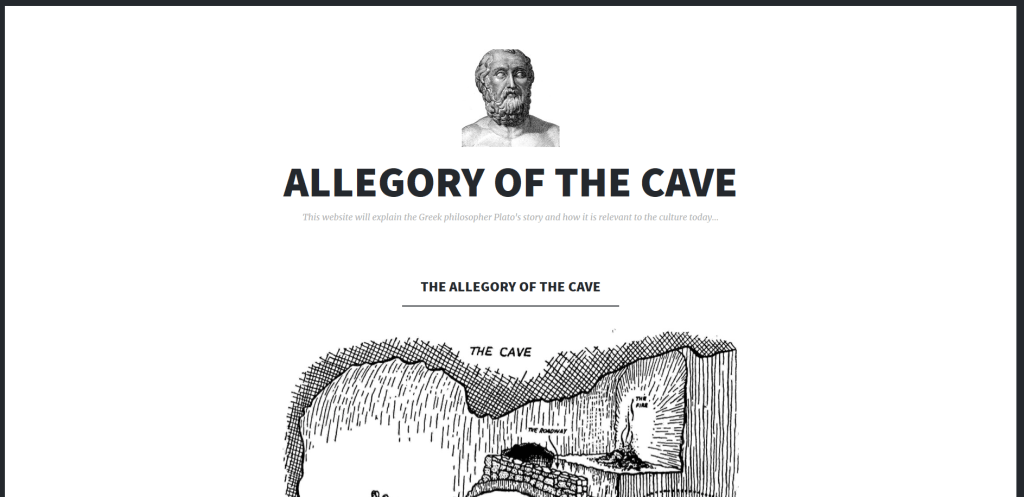
Step 2 was to choose the font I wanted, colours and what menus I would display. As this was a website just to show the story and image the extra menu bar above with ‘Home’ and ‘Contact’ wasn’t needed. However I did add a tagline below my heading explaining ‘This website will explain the Greek philosopher Plato’s story and how it is relevant to the culture today’.
Step 3 I would need to create a new post that would appear on the main page once you logged into the website. The post was titled ‘The Allegory of the Cave’ then I added a depictive drawing of the Cave below. I wanted to keep the website with the colour scheme of black, white and grey as it gave it a nice simplistic athetotic. In this post I wrote my information on the story.
Step 4 I uploaded a depiction of Plato to be the WordPress Logo and used it as my header image. This is because WordPress has this weird menu where you can’t use your header image as any size but luckily with this theme the logo position is in the top centre so I utilized this option instead. The site icon was same as the logo so on the tab on your internet browser you can see a small little Plato.
Overall I feel this website is simple but it gets the job done and doesn’t distract you away from the key information. In conclusion I am happy with my finished product.
Final product –
I have interred a screen shot of my blog to show the layout and I have also inserted the link to the actual final website I have created below.
Screen shots

Final Product – Website link
https://allegoryofthecavee.wordpress.com/
Evaluation
To conclude, for this project/ module, I decided that I wanted to create a minimalistic website focusing on a philosophical allegory or story focusing on human perception and knowledge. As I felt it has a more relevant and contemporary feel towards people then it does to legends and myths. The process of getting the final website completed was a fast paste one as of the circumstances, and was challenging as I decided to work on my own. Plus, the online classes were also confusing at first but there were only a few so it was alright in the end. I found this easy …. but the actual managing and creating of the website very difficult at first as I have not had much experience with website and blog making. However, in the end it was just a case of trial and error until I was happy with the result. Regarding the actual dynamic of how the classes took place it was interesting at first nut understanding the circumstances it was adaptable, the only thing it lacked was I did not feel I was being taught new things and that it was the same concepts and instructions from previous blog/web sessions in previous modules. On the other hand, through this module I have learnt that I am interested in this area within the media and could be a possible route to explore in the future.
 Developing Contemporary, Media Practice, Media Representations and Media Explorations